

If you’ve spent any time reading about AI, you’ve probably seen “machine learning” and “deep learning” used almost interchangeably sometimes in the same sentence, sometimes by the same author. That’s not entirely wrong, but it’s not precise either and the imprecision hides one of the most important ideas in modern technology.
Deep learning is not a competitor to machine learning. It’s a specific, more powerful approach that lives inside it. Understanding the difference is the key to understanding why tools like ChatGPT, self-driving cars, and voice assistants became possible only in the last decade, even though machine learning itself has existed since the 1950s.
This guide breaks down exactly what deep learning is, how it differs from traditional machine learning, how neural networks actually work under the hood, and when each approach makes sense.
The Short Answer
Machine learning is a broad field of AI where systems learn patterns from data instead of following hard-coded rules. Deep learning is a subset of machine learning that uses multi-layered artificial neural networks, systems loosely inspired by the human brain to learn those patterns automatically, without a human manually deciding which features in the data matter.
In other words: all deep learning is machine learning, but not all machine learning is deep learning. The “deep” refers to the number of layers in the neural network. According to IBM, a model generally needs at least four layers before it qualifies as a deep learning system.
If you want the full picture of how this fits into artificial intelligence as a whole, our guide on what artificial intelligence actually is covers the bigger category these both belong to.
What Is Machine Learning? A Quick Recap
Before comparing the two, it helps to be precise about machine learning itself. We covered this in depth in our full guide to machine learning, but here’s the short version.
Machine learning is a method of teaching computers to find patterns in data and make predictions or decisions without being explicitly programmed for every scenario. Instead of a developer writing “if this, then that” rules, a machine learning model is shown examples thousands or millions of them and it learns the statistical relationships on its own.
Traditional machine learning still leans heavily on humans, though. A data scientist typically has to perform what’s called “feature engineering” manually deciding which pieces of information in the data are actually relevant. If you’re building a model to predict house prices, a human decides that square footage, location and number of bedrooms probably matter and feeds those specific features to the algorithm.
This works well for structured like tabular data: spreadsheets, databases, numeric records. It is how banks have built credit scoring models for decades and how early spam filters worked. But it starts to break down with messier, unstructured data like photos, audio or natural language and that’s exactly the gap deep learning was built to close.
What Is Deep Learning?
According to IBM’s official definition, “deep learning is a subset of machine learning driven by multilayered neural networks whose design is inspired by the structure of the human brain.”
Instead of a human hand-picking which features matter, a deep learning model is fed raw data for example: a photo’s pixel values, the raw audio waveform, the raw text and it discovers the relevant features itself, layer by layer. The earliest layers of the network tend to pick up on very broad, simple patterns. In an image, that might be edges and contrast. Each subsequent layer combines what the previous layer found into something more complex, edges become shapes, shapes become textures, textures become objects until the final layer can confidently say “this is a cat” or “this is a stop sign.”
This layered structure is where the name comes from. A “shallow” network might have one or two layers. A “deep” network stacks many layers on top of each other like modern large language models use dozens, and some of the largest vision and language models use over a hundred.
Deep neural networks are sometimes described as universal approximators, meaning that with enough layers and enough data, they are theoretically capable of learning almost any pattern that exists in the data, no matter how complex or non-linear it is. Traditional machine learning models by contrast are usually built around a single, simpler mathematical function that has real limits on how complex a pattern it can capture.
How Deep Learning Differs From Machine Learning
The two terms get blurred together because deep learning technically is machine learning. But in practice, the differences show up in almost every part of the process the data you need, the hardware you need, how long training takes and even how much you can explain the model’s decisions after-ward.
Feature engineering. Traditional machine learning depends on humans manually selecting and engineering the input features. Deep learning learns the features automatically, directly from raw data.
Data requirements. Traditional machine learning can perform well with a few hundred or a few thousand labeled examples. Deep learning typically needs tens of thousands to millions of examples to reach strong performance, because it’s learning both the features and the patterns simultaneously.
Hardware. Classic machine learning models can be trained on a standard CPU in minutes. Deep learning models are computationally intensive enough that they generally require GPUs or specialized chips (TPUs) to train in a reasonable amount of time, because the underlying math involves massive amounts of parallel matrix multiplication.
Training time. A traditional model might train in seconds to minutes. Large deep learning models can take days or weeks, even on powerful hardware clusters.
Interpretability. Traditional machine learning models like decision trees or linear regression are often described as “white box” you can trace exactly why the model made a specific prediction. Deep learning models are frequently called “black boxes” because their decisions emerge from millions or billions of weighted connections that aren’t easily traced back to a simple, human-readable explanation.
Performance with unstructured data. This is the big one. Traditional machine learning struggles with images, audio and free-form text because there’s no obvious way to hand-engineer useful features from millions of raw pixel values. Deep learning was built for exactly this kind of data and is why it now dominates computer vision, speech recognition and natural language processing.
Performance at scale. Traditional machine learning models tend to plateau, feeding them more data past a certain point doesn’t meaningfully improve results. Deep learning models generally keep improving as you feed them more data and make the network larger, which is part of why AI progress has accelerated so quickly since the early 2010s.
How Deep Learning Actually Works, Explained Simply
You don’t need a math degree to understand the core mechanics. Here’s the simplified version.
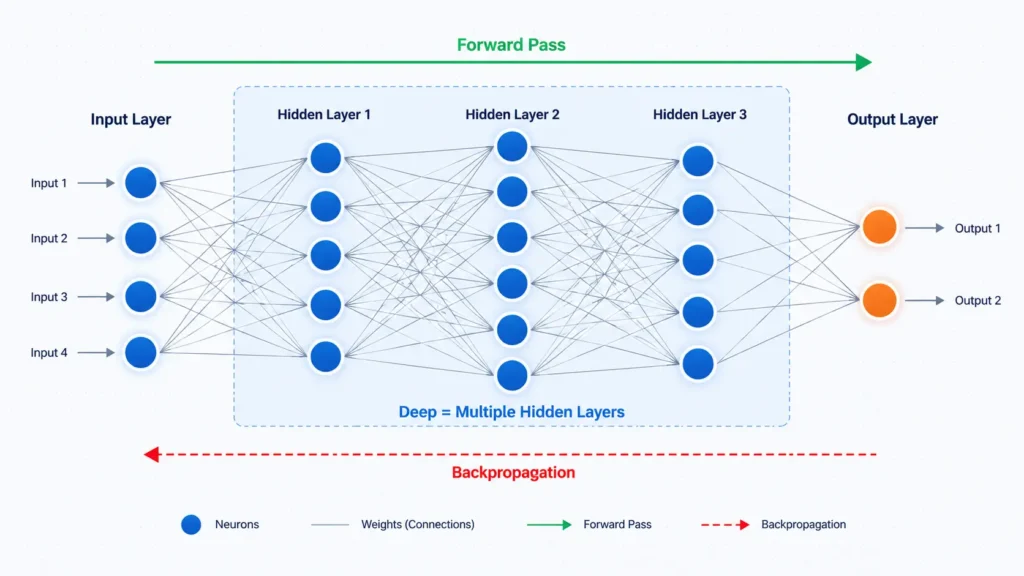
A neural network is organized into layers of artificial “neurons.” There’s an input layer (where raw data enters, pixel values, word tokens, audio samples), one or more hidden layers in between, and an output layer (where the final prediction comes out).
Every connection between neurons has a “weight” attached to it — essentially a number that determines how much influence one neuron has on the next. When data flows through the network, each neuron takes its inputs, multiplies them by their weights, adds a small adjustment called a “bias,” and passes the result through something called an activation function, which decides whether and how strongly that neuron should “fire” and pass information forward.
At the start, all these weights are essentially random, so the network’s first predictions are basically guesses. Training is the process of gradually adjusting every single weight in the network so its predictions get closer to the correct answer. This happens through a process called backpropagation: the network makes a prediction, compares it to the correct answer, calculates how wrong it was, and then works backward through the layers, nudging each weight slightly in the direction that would have reduced the error. This happens over and over often millions of times until the network’s predictions become reliably accurate.
It’s a bit like learning to shoot free throws by trial and error, except instead of one person adjusting their arm angle, you have millions of tiny adjustable dials, and after every shot, a very precise process tells every single dial exactly how much to turn and in which direction.
Types of Deep Learning Models
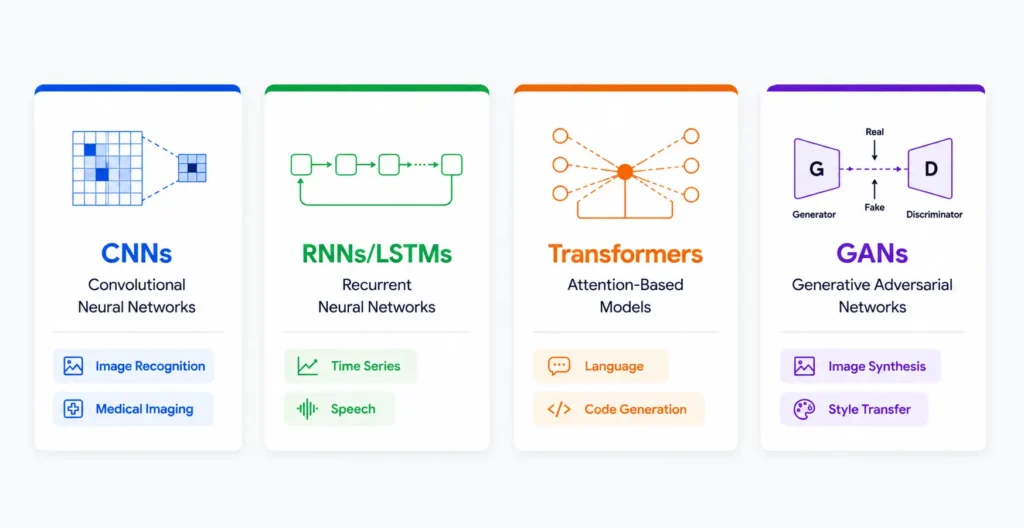
Not all deep learning architectures are built the same way. Different structures are suited to different kinds of data.
Convolutional Neural Networks (CNNs) are the backbone of computer vision. They’re designed to detect spatial patterns edges, shapes, textures that makes them the standard choice for image classification, facial recognition and medical imaging analysis.
Recurrent Neural Networks (RNNs) and LSTMs were designed for sequential data like text, speech, or time series, where the order of information matters. They process data step by step, carrying a kind of memory forward. They were the dominant approach for language tasks before 2017 but have largely been replaced by transformers for most modern applications.
Transformers are the architecture behind virtually every major AI breakthrough since 2017, when Google researchers published “Attention Is All You Need,” introducing a mechanism called self-attention that lets a model weigh the importance of every word in a sentence against every other word simultaneously, rather than processing it strictly in order. This is the architecture underneath ChatGPT, Claude, Gemini, and nearly every modern large language model. If you want the full story of how this changed the field, we cover it in our article on the history of artificial intelligence.
Generative Adversarial Networks (GANs) use two competing neural networks, a generator that creates fake data and a discriminator that tries to catch the fakes locked in a continuous contest that gradually makes the generated output more realistic. GANs were behind many early AI image generation tools before diffusion models became the more common approach.
Real-World Examples: Machine Learning vs. Deep Learning in Action
Seeing both approaches applied to similar problems makes the distinction concrete.
Traditional machine learning is what powers a bank’s credit scoring model, which weighs structured factors like income, credit history, and debt-to-income ratio using a relatively interpretable model. It’s what runs a lot of early email spam filters, which learned to flag suspicious word patterns and sender behavior. It’s also behind many recommendation systems that rely on structured purchase and rating history rather than raw content understanding.
Deep learning is what allows your phone to unlock by recognizing your face in any lighting condition. It’s what allows Siri, Alexa and Google Assistant to convert your spoken voice into text with high accuracy. It’s the technology behind self-driving cars identifying pedestrians, road signs, and other vehicles from camera footage in real time. And it’s the technology behind large language models like ChatGPT and Claude, which learned the structure and meaning of human language by training on enormous amounts of text.
A Brief History: Why Deep Learning Took Off When It Did
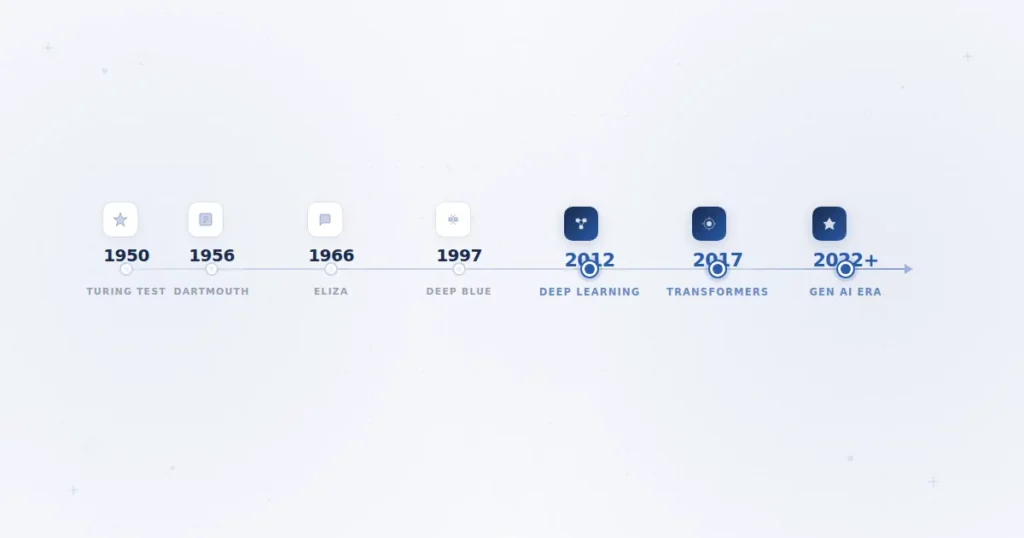
The core mathematical ideas behind neural networks aren’t new. Early versions, like the perceptron, date back to 1958, and we go through that full timeline in our history of AI article. But for decades, deep learning was a theoretical curiosity rather than a practical tool, held back by two hard limits: not enough data, and not enough computing power to train networks with many layers.
Both limits started to disappear in the 2000s and early 2010s. The internet produced massive amounts of labeled data. Graphics cards (GPUs), originally built for video game rendering, turned out to be extremely good at the exact kind of parallel matrix math that neural networks require.
The turning point most historians point to is 2012, when a deep convolutional neural network called AlexNet entered the ImageNet competition, a contest to correctly classify over a million labeled images into a thousand categories. AlexNet didn’t just win; it beat the next-best approach by a stunning margin, cutting the error rate nearly in half compared to traditional computer vision techniques. That result convinced the broader research community that deep learning wasn’t a niche technique, it was the future. Five years later, the 2017 transformer paper extended the same underlying philosophy to language, and the rest of the current AI boom follows directly from those two breakthroughs.
The Market Reflects the Shift
The scale of investment in deep learning specifically illustrates how central it has become to the broader AI economy. According to market research from Precedence Research, the global deep learning market was valued at approximately $125.65 billion in 2025, is projected to reach $168.48 billion in 2026, and is forecast to grow to over $1.6 trillion by 2035, a compound annual growth rate of roughly 29.26%. That growth is being driven by exactly the applications described above: computer vision, natural language processing, autonomous systems, and generative AI.
Advantages of Deep Learning
Deep learning’s biggest strength is that it removes the bottleneck of manual feature engineering, which means it can be applied to problems where humans don’t actually know what the “right” features would be. It handles unstructured data like images, audio, video, free text that is far better than traditional approaches. And unlike traditional machine learning, which tends to plateau, deep learning models generally keep improving as you add more data and make the network bigger, which is a large part of why progress in the field has compounded so quickly.
Limitations and Challenges
None of this makes deep learning strictly “better” in every situation. It requires massive labeled datasets that are expensive and time-consuming to gather. Training large models requires specialized, often expensive hardware. The resulting models are difficult to interpret, which is a real problem in regulated industries like healthcare and finance where you may need to explain why a decision was made. Deep learning models can also inherit and amplify biases present in their training data, sometimes in ways that are hard to detect until the model is already deployed. And for genuinely simple problems with small, clean, structured datasets, a traditional machine learning model will often match deep learning’s accuracy while training in a fraction of the time, at a fraction of the cost.
When Should You Use Machine Learning vs. Deep Learning?
As a practical rule: if your data is structured (spreadsheets, databases, numeric or categorical fields), your dataset is small to medium-sized, and you need to explain your model’s decisions, traditional machine learning is usually the better choice. It’s faster to train, cheaper to run and easier to audit.
If your data is unstructured such as images, audio, video or natural language and you have access to large amounts of training data and sufficient computing power, deep learning is almost always going to outperform traditional approaches, often by a wide margin.
In practice, most real-world AI systems use a mix of both, applying the simplest approach that solves the problem well rather than defaulting to the most complex one available.
The Future of Deep Learning
Current research is pushing in a few clear directions. Multi models that combine text, image, audio and video understanding in a single deep learning system are becoming the new standard, rather than separate models for each data type. There’s also a strong push toward efficiency smaller, distilled models that deliver most of the performance of massive models while running on a phone or laptop instead of a data center, sometimes called “edge AI.” And research into interpretability is trying to chip away at the black-box problem, giving researchers better tools to understand why a deep learning model made a specific decision, which matters enormously as these systems get deployed in higher-stakes settings like medicine and law.
Frequently Asked Questions
Is deep learning the same thing as AI? No. Artificial intelligence is the broadest category, any system that performs tasks that normally require human intelligence. Machine learning is a subset of AI. Deep learning is a subset of machine learning. Deep learning is currently the most powerful and widely used approach within AI, but it isn’t the entire field.
Do I need to understand deep learning to use tools like ChatGPT? No. Using AI tools requires no technical background at all. Understanding deep learning is only necessary if you’re building, training, or researching these systems yourself.
Is deep learning always better than traditional machine learning? No. For small, structured datasets where you need an explainable model, traditional machine learning is often faster, cheaper, and just as accurate. Deep learning’s advantages show up specifically with large amounts of unstructured data.
What programming languages and tools are used for deep learning? Python is the dominant language, primarily using frameworks like TensorFlow and PyTorch, which handle the underlying math and let researchers define network architectures without writing the calculus by hand.
Can deep learning work with a small amount of data? Generally, no this is one of its main limitations. Techniques like transfer learning, where a model pre-trained on a huge dataset is fine-tuned on a smaller, specific dataset, can help work around this, which is part of why pre-trained models have become so central to modern AI development.
How many layers does a network need to be considered “deep”? There’s no single universal rule, but IBM and most practitioners generally consider a neural network “deep” once it has at least four layers, including the hidden layers between input and output.
Why It Matters
Machine learning gave computers the ability to learn from data instead of following rigid rules. Deep learning gave them the ability to learn from the messiest, most human kinds of data images, speech, language, without a person having to tell them what to look for first. That single shift is the reason AI went from a niche academic field to something that now writes, sees, listens and talks back, all within about a decade.
If you’re just getting started with AI fundamentals, the logical next steps are our guides on what artificial intelligence actually is and how machine learning works, both of which this article builds directly on.



One thought on “What Is Deep Learning? How It Differs From Machine Learning (2026 Guide)”