
Notice: a link in this article is temporarily unavailable while the article is being updated. We apologize for the inconvenience. Last Updated August 14.
- Machine learning is a type of artificial intelligence that lets computers learn from data instead of being manually programmed with rules.
- There are three main types: supervised learning, unsupervised learning, and reinforcement learning — each works differently and solves different problems.
- Machine learning already powers everyday tools you use, including Netflix recommendations, spam filters, voice assistants, and Google Search.
- It is not the same as artificial intelligence — machine learning is one method within the broader field of AI.
- Machine learning models are not perfect. They depend heavily on the quality and quantity of data they’re trained on.
- You don’t need a technical background to understand how machine learning works — this guide explains everything in plain language.
Your email app knows which messages are spam before you even open your inbox. Netflix somehow picks movies you actually want to watch. Your phone recognises your face in a fraction of a second.
None of this is magic. It’s machine learning.
Machine learning is one of the most important ideas behind modern artificial intelligence. It’s the reason AI went from a research concept to something that affects your life every single day. And yet most people don’t really understand what it is or how it works.
This guide breaks it down. No jargon, no math, no prerequisites. By the end, you’ll understand what machine learning actually does, how it learns, what types exist, and where you encounter it without even realizing.
What Is Machine Learning?
Machine learning is a method that allows computers to learn from data and improve their performance over time — without being explicitly programmed with step-by-step instructions.
In Simple Terms: Instead of telling a computer exactly what to do, you show it thousands of examples and let it figure out the patterns on its own.
Traditional programming works like a recipe. A developer writes specific rules: “If the email contains the word ‘prize’ and a suspicious link, mark it as spam.” The computer follows those rules exactly. Nothing more, nothing less.
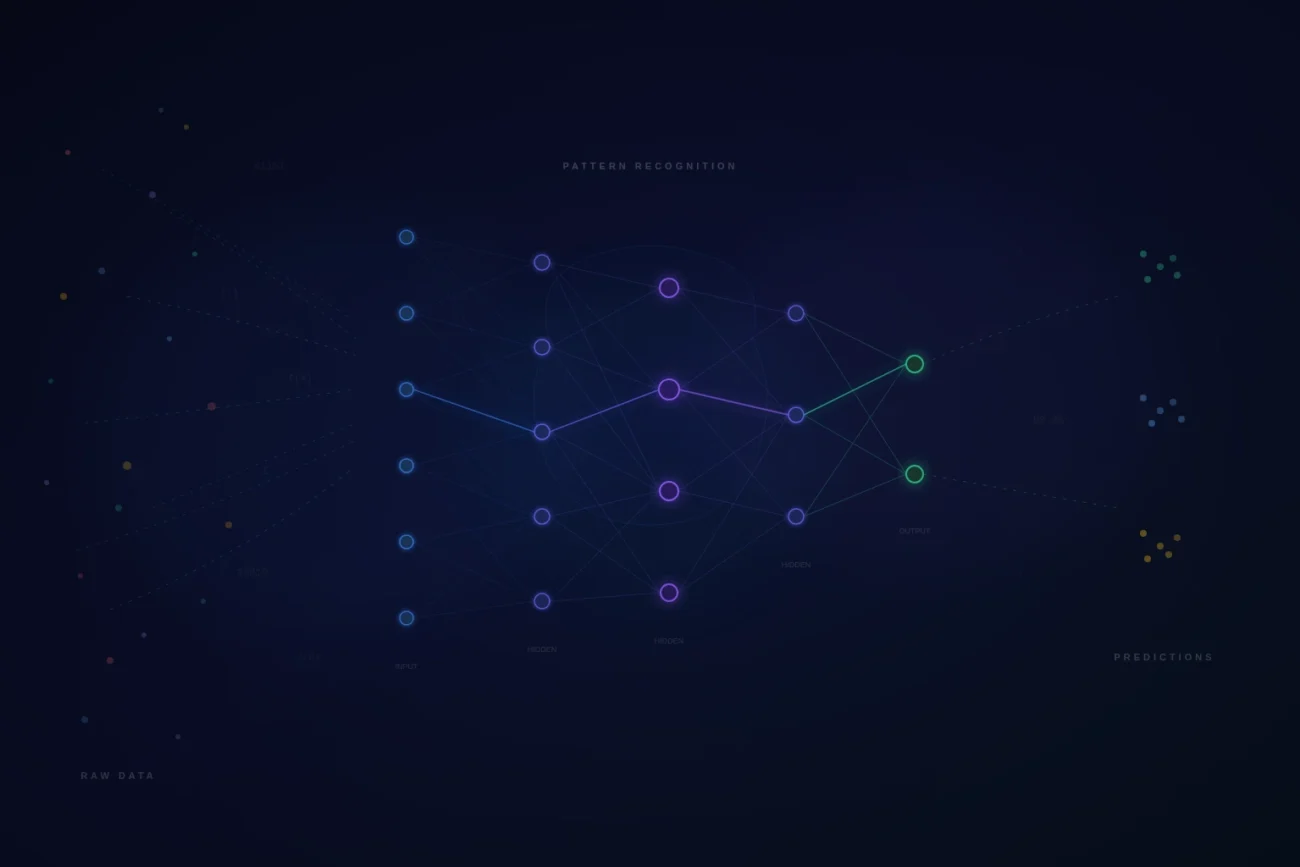
Machine learning flips this. Instead of writing rules, you feed the computer thousands of emails that are already labeled as “spam” or “not spam.” The computer studies those examples, identifies patterns, and builds its own rules. The more data it processes, the better it gets at making the right call.
This is why machine learning matters. Writing rules works for simple problems. But for complex tasks — like recognizing faces, understanding speech, or predicting what song you’ll enjoy — there are too many variables for a human to write rules for. Machine learning handles that complexity automatically.
How Does Machine Learning Work?
Machine learning follows a process. It’s not random. Every machine learning system — whether it recommends songs on Spotify or detects fraud at your bank — goes through the same basic steps.
Collecting Data
Everything starts with data. Machine learning cannot work without it.
If you want to build a system that identifies cats in photos, you need thousands of photos — some with cats, some without. If you want to predict house prices, you need data on past sales: square footage, location, number of bedrooms, and the price each house sold for.
The data is the raw material. The quality and quantity of this data directly determines how well the machine learning model will perform.
Finding Patterns
Once the data is collected, the system starts looking for patterns.
In the house price example, it might notice that houses with more square footage tend to sell for higher prices. Or that homes in certain neighborhoods consistently cost more. These aren’t rules a programmer wrote — the system discovers them on its own by analyzing the data.
This step is the core of machine learning. The system is essentially asking: “What patterns in this data help me predict the right answer?”
Training a Model
A model is the system that the machine builds from the data. Think of it as the machine’s understanding of the problem.
During training, the model makes predictions, checks whether they’re right, and adjusts itself. It does this thousands or millions of times. Each cycle makes the model slightly more accurate.
In Simple Terms: Training is like studying for an exam. The model reads the material (data), takes practice tests (makes predictions), and learns from its mistakes (adjusts itself).
Making Predictions
Once training is complete, the model is ready to work on new data it has never seen before.
You show it a house it wasn’t trained on, and it predicts a price. You send it a new email, and it decides whether it’s spam. You upload a photo, and it tells you whether there’s a cat in it.
This is where the value of machine learning becomes real. The model generalizes what it learned from old data and applies it to new situations.
Improving Over Time
Machine learning models don’t have to stay frozen after training. Many systems continue learning as they receive new data.
Every time you mark an email as spam in your inbox, you’re feeding new data to the model. It adjusts. It gets better at catching the types of spam you personally receive. This ongoing improvement is one of the biggest advantages machine learning has over traditional programming.
Types of Machine Learning
Not all machine learning works the same way. The method used depends on the type of data available and the problem being solved. There are three main types.
Supervised Learning
Supervised learning is the most common type. The model is trained on data that already has the correct answers attached.
Imagine you’re teaching a child to recognize fruit. You hold up an apple and say “apple.” You hold up a banana and say “banana.” After enough examples, the child can identify fruit on their own. Supervised learning works the same way.
The “supervision” is the labeled data — each piece of training data comes with the right answer. The model learns the connection between the input (a photo of fruit) and the label (the name of the fruit).
In Simple Terms: You give the computer both the question and the answer. It learns the pattern connecting them.
Common uses: email spam detection, medical diagnosis from scans, credit scoring, and price prediction.
Unsupervised Learning
Unsupervised learning works without labeled data. The model receives raw data with no answers attached and has to find structure on its own.
Think of it like sorting a pile of mixed buttons. Nobody tells you how to sort them. You might group them by color, by size, or by shape. The machine does something similar — it finds natural groupings in the data.
In Simple Terms: You give the computer only the questions. It figures out how to organize the answers by itself.
Common uses: customer segmentation (grouping shoppers by behavior), anomaly detection, recommendation engines, and data exploration.
Reinforcement Learning
Reinforcement learning is different from both supervised and unsupervised learning. The model learns through trial and error, receiving rewards for good decisions and penalties for bad ones.
Picture training a dog. You don’t show the dog a manual. When it sits on command, it gets a treat. When it doesn’t, no treat. Over time, the dog learns which behaviors earn rewards. Reinforcement learning follows the same principle.
In Simple Terms: The computer learns by doing — trying things, getting feedback, and adjusting its behavior based on what works.
This approach is behind some of the most impressive AI achievements, including AlphaGo beating the world champion at Go and AI systems learning to play video games at superhuman levels. It’s also the foundation of how self-driving cars learn to navigate roads.
Semi-Supervised Learning
Semi-supervised learning sits between supervised and unsupervised. It uses a small amount of labeled data combined with a large amount of unlabeled data. This is practical because labeling data is expensive and time-consuming. Semi-supervised methods let machines get strong results without needing every single data point labeled by a human.
Machine Learning vs Artificial Intelligence vs Deep Learning
These three terms get mixed up constantly. Here’s how they actually relate to each other.
Artificial intelligence is the broadest concept. It refers to any system designed to perform tasks that normally require human intelligence — understanding language, recognizing images, making decisions.
Machine learning is one approach within AI. Instead of programming intelligence manually, you let the system learn it from data. Not all AI uses machine learning, but most modern AI does.
Deep learning is a specific technique within machine learning. It uses neural networks with many layers to handle extremely complex tasks like image recognition and language translation.
In Simple Terms: AI is the goal. Machine learning is one way to get there. Deep learning is a powerful version of machine learning.
Think of it like transportation. AI is the concept of getting from point A to point B. Machine learning is using a car. Deep learning is using a high-performance sports car — faster and more powerful, but built on the same basic idea.
If you want to understand how all of this developed over time, the history of artificial intelligence shows how machine learning grew from a theoretical idea in the 1950s into the technology running the world’s biggest products today.
Real-World Examples of Machine Learning
Machine learning isn’t a future technology. You interact with it multiple times a day, usually without knowing it.
Recommendation Systems
When Netflix suggests a show or Spotify builds a playlist for you, that’s machine learning. These systems analyze your past behavior — what you watched, what you skipped, how long you listened — and find patterns. Then they compare your patterns to millions of other users and predict what you’ll enjoy next.
YouTube’s recommendation algorithm uses the same approach. It’s one of the most powerful machine learning systems ever built, responsible for over 70% of the total time people spend watching videos on the platform.
Virtual Assistants
Siri, Alexa, and Google Assistant all use machine learning to understand your voice. The system converts your speech to text, interprets what you’re asking, and generates a response.
These assistants improve over time. The more people use them, the more data the system collects, and the better it gets at understanding accents, slang, and context.
Fraud Detection
Banks use machine learning to detect fraudulent transactions in real time. The system learns your normal spending patterns — where you shop, how much you spend, what time of day you make purchases.
When something unusual happens — like a large purchase in a foreign country at 3 AM — the model flags it. This happens within milliseconds, fast enough to block the transaction before it goes through.
Medical Diagnosis
Machine learning models can analyze medical images — X-rays, MRIs, CT scans — and detect signs of disease. Some models now match or outperform human doctors at detecting certain cancers, eye diseases, and skin conditions.
This doesn’t replace doctors. It gives them a second opinion and helps catch things that might be missed during a busy shift.
Self-Driving Cars
Autonomous vehicles use machine learning to interpret their surroundings. Cameras, radar, and sensors collect data about the road, pedestrians, traffic signs, and other vehicles. Machine learning models process this data in real time to make driving decisions.
This is one of the most complex applications of machine learning because the stakes are high and the environment is constantly changing.
Language Translation
Google Translate and similar tools use machine learning to translate between languages. Early translation tools used word-for-word replacement, which produced awkward results. Modern systems learn the structure, grammar, and meaning of entire sentences by studying millions of translated documents.
The result is translation that sounds natural — not perfect, but dramatically better than what existed even five years ago.
Benefits of Machine Learning
Handles Complexity That Humans Can’t
Some problems have too many variables for humans to analyze manually. Machine learning thrives on this complexity. It can process millions of data points and find patterns that would take a human team years to discover.
Automates Repetitive Decisions
Instead of having a person review every transaction for fraud or every email for spam, machine learning handles these decisions automatically and at scale. This frees people to focus on work that requires human judgment.
Gets Better With More Data
Unlike traditional software that stays the same unless a developer updates it, machine learning systems improve as they process more data. The more examples they see, the more accurate they become.
Works Around the Clock
Machine learning models don’t need breaks. They process data, make predictions, and flag problems 24 hours a day. This is why banks can monitor transactions and hospitals can analyze scans continuously.
Personalizes Experiences
Machine learning is the engine behind personalization. It’s why your social media feed, shopping recommendations, and music playlists feel tailored to you specifically. It learns your individual preferences and adapts.
Limitations of Machine Learning
It’s Only as Good as Its Data
The most important limitation. If the training data is incomplete, biased, or low quality, the model will make poor predictions. A facial recognition system trained mostly on one demographic will perform poorly on others. Garbage in, garbage out.
It Can Be a Black Box
Some machine learning models — especially deep learning models — are difficult to explain. They give you an answer, but they can’t always tell you why. In fields like medicine and law, where explanations matter, this is a real problem.
It Requires a Lot of Data
Machine learning generally needs large amounts of data to work well. For niche problems where data is scarce, building an effective model can be extremely difficult or even impossible.
It Can Reinforce Bias
If historical data reflects human biases — and it often does — the machine learning model will learn and repeat those biases. Hiring algorithms trained on biased past decisions have been shown to discriminate against certain candidates.
It’s Not True Understanding
Machine learning models don’t “understand” anything in the way humans do. A model that predicts house prices doesn’t know what a house is. It recognizes statistical patterns. This means it can fail in unexpected ways when it encounters situations that don’t match its training data.
It’s Expensive to Build Well
Training high-quality machine learning models requires significant computing power, specialized talent, and time. Large language models can cost millions of dollars to train. This puts cutting-edge machine learning out of reach for most small organizations.
The Future of Machine Learning
Machine learning is moving fast, and several trends are shaping where it goes next.
Models are getting smaller and more efficient. The early focus was on building bigger models with more data and more computing power. Now the emphasis is shifting toward creating models that deliver strong results while using less energy and running on everyday devices. This means machine learning will increasingly work on your phone, your watch, and home devices — without needing an internet connection.
Machine learning is also becoming more accessible. Tools and platforms now let people with no coding experience build and deploy machine learning models. This democratization means more industries — from farming to local retail — will start using machine learning to solve problems specific to their work.
The combination of machine learning with other AI capabilities is accelerating. Systems that can see, hear, read, and reason are becoming standard. Multimodal AI — models that process text, images, audio, and video together — represents the next big leap.
At the same time, the conversation around responsible machine learning is growing. Questions about bias, transparency, privacy, and regulation are becoming central to how machine learning systems are designed and deployed. Building models that work well is no longer enough — they also need to work fairly.
Conclusion
Machine learning is not as complicated as it sounds. At its core, it’s a simple idea: give a computer enough examples, and it can learn to make predictions on its own.
What makes it powerful is scale. Humans can’t manually process billions of data points, detect patterns across millions of transactions, or personalize experiences for hundreds of millions of users. Machine learning can.
It’s already embedded in your daily life — in your inbox, your streaming apps, your bank, your phone. And it’s expanding into healthcare, education, transportation, and nearly every other industry.
Understanding how machine learning works gives you a real advantage. Not because you need to build models yourself, but because the technology is shaping decisions that affect you — from what content you see online to whether your loan application gets approved.
The more you understand it, the better equipped you are to navigate a world that runs on it.


2 thoughts on “What Is Machine Learning? A Beginner’s Guide”