
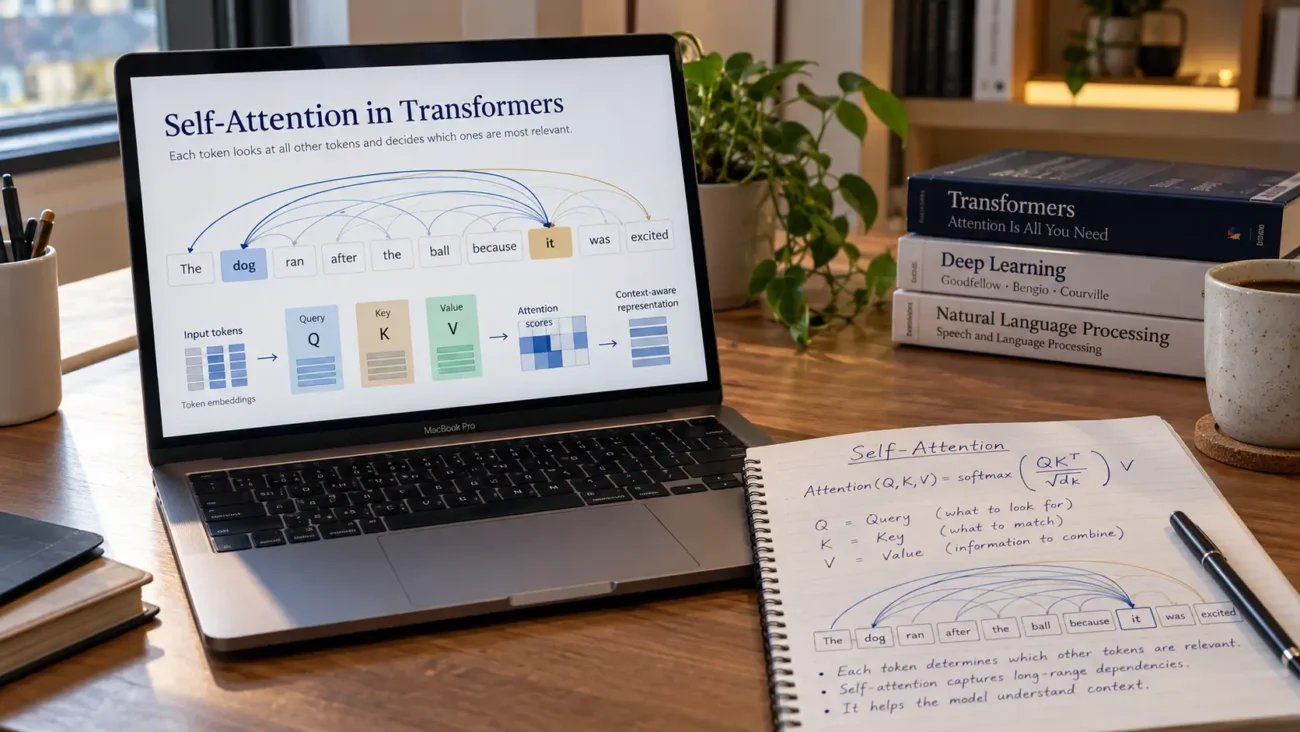
When you read a sentence, you rarely treat every word as equally important. Your understanding of one word often depends on another word somewhere else in the sentence. Consider: “The dog ran after the ball because it was excited.” To understand what “it” refers to, you need to connect it with the surrounding context. AI models face the same basic problem. A language model cannot simply process words as isolated pieces. It needs a way to determine which parts of a sequence are relevant to one another. Self-attention provides that mechanism.
Self-attention is a core component of the Transformer architecture, the neural-network design introduced in the 2017 paper Attention Is All You Need. The original Transformer was developed for sequence-to-sequence tasks such as machine translation, but the architecture later became foundational to many modern language models. That makes self-attention an important concept for understanding everything from modern natural language processing to large language models.
Key Takeaways
- Self-attention lets tokens interact with other tokens in the same sequence.
- Each token is transformed into a Query, Key and Value representation.
- The model calculates attention scores to determine which information is more relevant.
- Scaled dot-product attention converts those scores into weights that are used to combine information.
- Multi-head attention allows the model to examine relationships from several representation spaces at the same time.
- Decoder-based language models use causal masking so a token cannot attend to future tokens during generation.
- Self-attention is powerful, but full attention becomes more expensive as sequence length increases because its computation and memory requirements grow roughly quadratically with sequence length.
What Is Self-Attention in AI?
Self-attention is a mechanism that allows different tokens within the same sequence to interact and exchange information. Rather than processing each token independently, the model evaluates relationships between positions in the sequence and uses those relationships to create richer representations.
The word self matters because the queries, keys and values all come from the same sequence. In a sentence, for example, the representation of one token can be influenced by other tokens appearing before or after it. This gives the model a way to incorporate context directly. Google’s explanation of the original Transformer describes how a word such as “bank” can use information from another word such as “river” to help resolve its meaning.
Self-attention therefore does not mean that a model “thinks” about words in the same way a person does. It is a mathematical operation that calculates relationships between learned vector representations.
The underlying idea is simple:
look at the available context → estimate relevance → combine useful information → create a better representation
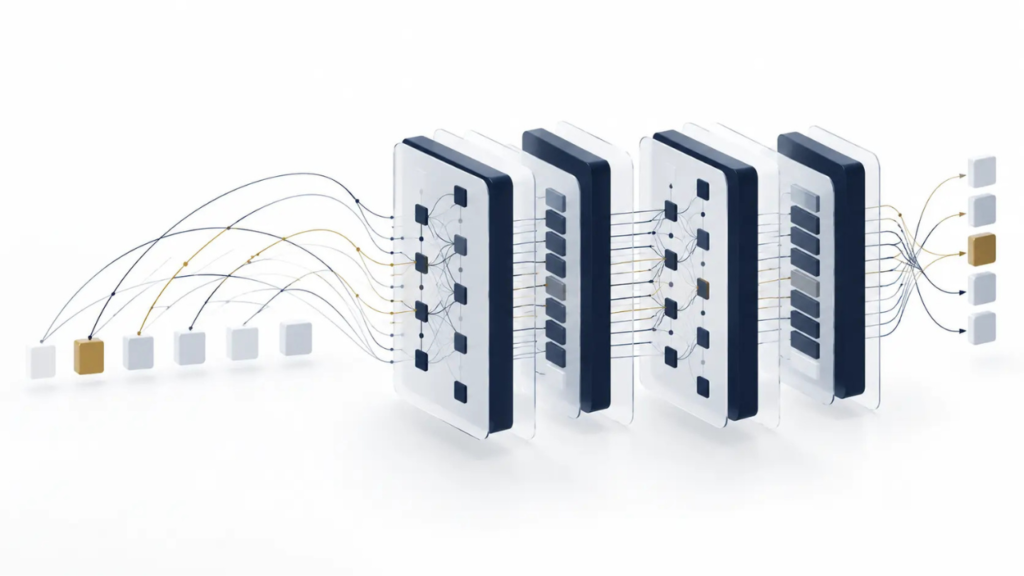
That operation is repeated throughout Transformer layers, allowing representations to become increasingly contextual.
Why Does AI Need Attention?
Earlier sequence models, including recurrent neural networks, processed information sequentially. One token was processed, information was carried forward, and then the next token was handled. That approach could work well, but long sequences created a difficult problem. Information from much earlier in a sequence had to pass through many recurrent steps before influencing a later token.
Transformers approached the problem differently. Instead of depending on recurrence to move information through a sequence, they used attention to model relationships between positions more directly. The original Transformer was designed without recurrence or convolution as its primary sequence-processing mechanism.
If you want the larger architectural picture first, LegacyVia’s Transformer models guide explains how the architecture developed, how it processes tokens, and how encoder-only, decoder-only and encoder-decoder designs differ.
Self-attention is therefore best understood as one of the central mechanisms inside a Transformer, not as a separate type of AI model.
How Does Self-Attention Work?
The easiest way to understand self-attention is to follow what happens to a short sequence. Suppose the input is :
The cat sat on the mat.
The model first receives the sequence as numerical representations rather than as raw human-readable words. Tokenization converts text into tokens, and those tokens are represented numerically before entering the Transformer.
Your natural language processing guide covers this broader pipeline, including tokenization, preprocessing, embeddings, language understanding and generation. Once the representations are available, self-attention calculates how strongly the tokens should interact. The mechanism is commonly described using three vectors:
Query (Q)
Key (K)
Value (V)
These three terms sound abstract, but their roles become easier to understand when you think of them as parts of an information-matching process.
What Are Query, Key and Value?
A Query represents what a token is looking for. A Key represents information that can be compared against that query. A Value contains the information that can be passed forward when a particular key receives attention.
For example, imagine the model is processing the word “cat.” The representation associated with that position produces a query. The model compares that query with the keys associated with other tokens and calculates how compatible they are. If another token is highly relevant, its value can contribute more strongly to the updated representation of “cat.” This is not a literal search process.
There is no internal database being queried. Query, Key and Value are learned numerical representations produced by transformations of the input. The terminology is simply a useful way to describe the mathematics. In the original Transformer formulation, the attention operation is defined using Query, Key and Value matrices.
The Self-Attention Formula
The core operation is called scaled dot-product attention.
The original Transformer paper defines it as:
This equation looks intimidating, but each part has a specific role.
Compare Queries and Keys
The model calculates the dot product between each query and the corresponding keys. In simple terms, this produces a measure of how strongly different positions relate to one another.
Scale the Scores
The scores are divided by:
where is the dimension of the key vectors. The scaling helps prevent the dot products from becoming excessively large, which would make the subsequent softmax distribution too extreme.
Apply Softmax
The softmax function converts the scores into normalized weights. The resulting values indicate how much influence different tokens should have.
Combine the Values
The attention weights are multiplied by the Value vectors and combined. The result is a new representation containing information gathered from the relevant parts of the sequence. The complete operation can therefore be thought of as:
compare → scale → normalize → combine
That is the mathematical heart of self-attention.
A Simple Example of Self-Attention
Consider this sentence:
The animal crossed the road because it was frightened.
When the model processes the word “it,” several earlier tokens may be relevant. The model doesn’t simply assume that the nearest word is the answer. Instead, self-attention allows the representation at “it” to incorporate information from other positions.
A learned attention pattern might give stronger weight to “animal” than to unrelated words such as “road” or “because.” The resulting representation of “it” can therefore contain contextual information gathered from elsewhere in the sentence.
Google’s original Transformer explanation uses a similar example involving “bank” and “river”: the model can use the surrounding context to distinguish the intended meaning of an ambiguous word. This is one reason self-attention is so useful for language. A token can receive information from another relevant token even when the two positions are far apart.
Self-Attention and Context
Context is one of the biggest reasons self-attention matters. Take the two sentences:
The bank is closed today.
and:
We sat on the bank of the river.
The word “bank” appears in both sentences, but its meaning is different. A model that represents the word in isolation would have difficulty capturing that difference. A contextual representation can use surrounding words to distinguish the meanings.
Self-attention helps create those contextual representations by allowing tokens to exchange information. This connects directly to the broader problem addressed by natural language processing: computers need representations that capture more than the literal sequence of symbols.
How Self-Attention Differs From RNNs
Self-attention became especially important because it changed how sequence information could be processed.
An RNN processes a sequence step by step:
Token 1
   ↓
Token 2
   ↓
Token 3
   ↓
Token 4
Information is carried forward through the sequence. Self-attention instead creates direct relationships between positions:
Token 1 ↔ Token 2
   ↕        ↕
Token 3 ↔ Token 4
The original Transformer paper proposed replacing recurrence with attention, which allowed much more parallel computation during training.
This distinction is explained visually in LegacyVia’s neural network types guide, which compares RNN-style sequential processing with Transformer self-attention.
The difference does not mean RNNs suddenly became useless. It means Transformers offered a different architectural approach that proved particularly effective for large-scale sequence modeling.
Does Self-Attention Understand Word Order?
There is an important problem. Self-attention itself compares relationships between tokens, but language also depends heavily on order. Consider:
The dog chased the cat.
and:
The cat chased the dog.
The same basic words appear in both sentences, but their meanings differ because the positions and relationships have changed. The original Transformer therefore added positional encoding so the model could incorporate information about where tokens occur in the sequence.
Modern Transformer models can use different approaches to represent positional information, but the underlying requirement remains: the model needs information about sequence position in addition to token identity. This is another reason why self-attention should not be thought of as the entire Transformer. It is one component within a larger architecture.
What Is Multi-Head Attention?
A Transformer does not have to perform only one attention calculation. The original architecture introduced multi-head attention, where several attention operations run in parallel using different learned projections.
The basic idea is useful because a sentence can contain several types of relationships at the same time. One attention head might learn a useful pattern involving syntactic relationships. Another may capture relationships between different positions. Another could learn patterns that are useful for a particular representation or task.
It is important not to interpret individual heads too literally, however. A particular attention head is not guaranteed to correspond neatly to one human-defined linguistic rule. The useful idea is simply that multiple heads give the model several representation spaces through which it can examine relationships.
The results of those heads are combined and transformed before being passed deeper into the network.
Self-Attention Inside a Transformer Block
Self-attention is only one part of a Transformer block. A simplified view looks like this:
Input representations
        ↓
Self-attention
        ↓
Residual connection
        ↓
Normalization
        ↓
Feed-forward network
        ↓
Residual connection
        ↓
Normalization
        ↓
Next Transformer block
The exact architecture varies across model families, but this gives a useful conceptual picture. Our article on neural networks explains the broader idea of layers, hidden representations and how neural networks transform input information through successive stages.
The original Transformer used stacked encoder and decoder blocks. Modern models can use different configurations depending on their objective.
Encoder Self-Attention vs Decoder Self-Attention
Not all self-attention works under exactly the same conditions. In an encoder, self-attention can generally allow a token to use information from other positions across the input sequence.
A decoder used for autoregressive generation has an additional restriction. When generating text, the model should not be allowed to look at tokens that have not been generated yet. For example, when predicting:
The capital of France is …
the model can use the tokens already available, but it cannot use the answer token from the future to help predict itself. This is handled through a causal mask, which prevents attention from flowing to future positions during autoregressive generation. That masking is fundamental to decoder-only language models.
What Is Causal Self-Attention?
Causal self-attention is self-attention with a directional restriction. Imagine five positions:
1 2 3 4 5When processing position 3, the model can attend to:
1 2 3but not:
4 5This preserves the autoregressive prediction task.
The model can therefore learn:
Given everything I have seen so far, what should come next?
This principle is closely connected to how decoder-only large language models generate text one token at a time. When you type a prompt into a generative language model, the model repeatedly predicts the next token while maintaining the context of the tokens that came before it.
Self-Attention and Large Language Models
Self-attention became particularly important when Transformer architectures were scaled into increasingly capable language models. A language model needs to represent relationships within its context. Self-attention gives it a mechanism for repeatedly mixing information between positions across Transformer layers. As the model moves through those layers, the representation at each position can become increasingly contextual.
This is one reason the development of large language models is so closely tied to Transformer architecture. The broader history matters too. The 2017 Transformer paper introduced the architecture; later research and engineering developments built increasingly large and capable models on Transformer-based designs. LegacyVia’s AI history guide places the 2017 Transformer paper within the larger development of modern AI.
How Self-Attention Connects to Deep Learning
Self-attention is not separate from deep learning. It operates inside neural networks trained through the methods of modern deep learning. That distinction matters because the attention mechanism itself does not “know” what relationships are important beforehand. Its parameters are learned through training.
This is where deep learning provides the larger foundation. Deep neural networks learn useful representations by adjusting parameters based on training data. Self-attention gives a Transformer one way to transform and combine those representations.
So the hierarchy is approximately:
Artificial intelligence
        ↓
Machine learning
        ↓
Deep learning
        ↓
Neural networks
        ↓
Transformers
        ↓
Self-attention
Each level describes a different part of the technical picture.
For a broader foundation, LegacyVia’s machine learning guide explains how models learn patterns from data and how that differs from traditional rule-based programming.
Why Self-Attention Became So Important
The importance of self-attention comes from more than one property. First, it provides a direct mechanism for modeling relationships between positions in a sequence.
Second, Transformer architectures allow much more parallel computation during training than recurrent sequence models, because they do not depend on processing the entire sequence strictly one step at a time. The original paper demonstrated this advantage on machine translation tasks.
Third, the architecture can be stacked into many layers, giving the model repeated opportunities to transform its representations. Together, these characteristics made Transformers highly compatible with the large datasets and computing resources used in modern deep learning.
That helped move attention from a specialized mechanism into one of the central ideas behind contemporary AI systems.
What Are the Limitations of Self-Attention?
Self-attention is powerful, but it is not free.
The standard full self-attention operation compares every position with every other position. As the sequence becomes longer, the amount of computation and memory required grows roughly with the square of sequence length. Google Research has highlighted this quadratic scaling as a major limitation of standard attention for long sequences.
For example, doubling the sequence length can substantially increase the cost of forming all pairwise attention relationships. This becomes important for applications that need very long contexts, such as large documents, long conversations, code repositories or other extensive sequences.
Researchers have developed different approaches to reduce this cost, including sparse and more efficient attention mechanisms. So while self-attention is central to Transformers, improving its efficiency remains an important area of research.
Is Attention the Same as Human Attention?
No.
The word attention is borrowed from a human concept, but the mechanism in a neural network is mathematical. A Transformer does not consciously decide that one word is interesting. It calculates numerical relationships using learned parameters and produces weighted combinations of representations.
This distinction is important because visualizing an attention pattern does not automatically provide a complete explanation of everything a model has learned. Self-attention tells us how the operation combines information. It does not mean the model is reasoning in a human-like way.
That is why it is safer to describe attention as a computational mechanism for weighting relationships between representations.
Self-Attention vs Cross-Attention
Self-attention and cross-attention are related, but they are not the same operation. In self-attention, the queries, keys and values come from the same sequence or representation set.
In cross-attention, the queries come from one representation while the keys and values come from another. The original encoder-decoder Transformer used cross-attention in the decoder so that the decoder could use information produced by the encoder. This distinction becomes especially useful when studying sequence-to-sequence systems.
For example:
Source sequence
      ↓
Encoder
      ↓
Encoder representation
      ↓
Cross-attention
      ↑
Decoder
      ↓
Output sequence
Understanding this difference makes it easier to understand why the term “attention” can refer to several closely related mechanisms.
Self-Attention in Generative AI
Self-attention also helps explain why modern generative AI systems can work with complex language context. A generative model does not simply retrieve a ready-made paragraph from a database. During generation, a decoder-style language model repeatedly processes the context available to it and predicts a next token.
Causal self-attention helps the model determine how earlier tokens should influence the next prediction. As generation continues, each newly produced token becomes part of the available context.
This creates a repeated cycle:
Existing context
      ↓
Causal self-attention
      ↓
Next-token prediction
      ↓
New token
      ↓
Updated context
      ↓
Repeat
That process is one of the foundations underlying modern text generation.
A Simple Mental Model
You can remember self-attention with one sentence:
Each token looks at the other available tokens, estimates which ones matter, and uses that information to build a richer representation of itself.
The technical process is more precise:
- Create Query, Key and Value representations.
- Compare Queries against Keys.
- Scale the resulting scores.
- Apply softmax to obtain attention weights.
- Combine the Value vectors using those weights.
- Pass the resulting representations through the rest of the Transformer block.
Repeat that process across layers and attention heads, and the model can build increasingly contextual representations.
That is the central idea.
Why Self-Attention Matters for the Future of AI
Self-attention is important not because it is the final form of AI, but because it became a highly useful mechanism for processing relationships across sequences.
The original Transformer paper was published in 2017. Since then, Transformer-based architectures have expanded from machine translation into language modeling and many other domains. Google’s research has also explored applications beyond text, including images and other types of data.
The next generation of AI systems will likely continue experimenting with how models represent context, manage longer sequences, reduce computational cost and combine different types of information. Understanding self-attention therefore gives you a useful technical foundation for understanding many of the systems that followed the Transformer. For a beginner, the learning path is straightforward:
neural networks → deep learning → Transformers → self-attention → large language models → generative AI
LegacyVia’s AI category brings these foundational topics together in one place.
FAQ’s
Self-attention is a mechanism that allows different tokens in the same sequence to interact and exchange information. It calculates relationships between positions and uses those relationships to create more contextual representations.
Query, Key and Value are learned vector representations used by the attention mechanism. Queries are compared with Keys to determine relevance, and the resulting weights are used to combine the Values.
Self-attention allows Transformer models to represent relationships between positions in a sequence directly. It also supports highly parallel computation during training compared with recurrent approaches.
Multi-head attention performs several attention operations in parallel using different learned projections. Their outputs are combined to produce the representation passed to later parts of the Transformer.
Causal self-attention prevents a token from attending to future positions. It is used in autoregressive generation so a language model cannot use information from tokens that have not yet been generated.
No. Self-attention is a mechanism used inside Transformer architectures. A Transformer also contains other components, such as feed-forward networks, residual connections and normalization, depending on the architecture.
Self-attention helps a model represent relationships between tokens, but it should not be interpreted as human-like understanding. It is a learned mathematical operation inside a neural network.
Self-attention uses queries, keys and values from the same representation set. Cross-attention uses queries from one representation and keys and values from another.
Standard full self-attention compares every position with every other position, causing computation and memory requirements to grow roughly quadratically as sequence length increases.
Bold Text Meaning
Self-attention : A mechanism that lets each token consider other tokens in the same sequence and determine which ones are relevant to its meaning.
Transformer architecture : A neural-network architecture that uses attention mechanisms to process relationships between tokens and is the foundation of many modern language models.
Natural language processing : The area of AI concerned with enabling computers to process, interpret, and generate human language.
Query : A learned representation that represents what information a token is looking for from other tokens.
Key : A learned representation that tells the model what information a token offers for comparison with a Query.
Value : The learned representation containing the actual information that is combined and passed forward according to the attention weights.
Scaled dot-product attention : The mathematical attention operation that compares Queries with Keys, scales the scores, converts them into weights, and uses those weights to combine Values.
Order : The position or sequence in which tokens appear in a sentence.
Positional encoding : Information added to token representations so the model can know where each token occurs in the sequence.
Multi-head attention : A method that runs several attention operations in parallel so the model can capture different relationships between tokens.
Causal mask : A restriction that prevents a token from using information from future tokens during text generation.
Computational mechanism for weighting relationships between representations : A mathematical process that assigns different levels of importance to relationships between token representations.
Cross-attention : An attention mechanism where the Queries come from one representation while the Keys and Values come from another.
Sources and Further Reading
Primary research
- Attention Is All You Need — Vaswani et al., 2017. This is the original Transformer paper and the primary technical source for scaled dot-product attention, multi-head attention and the Transformer architecture.
- Google Research: The Transformer — Google’s explanation of the Transformer and self-attention.
- Google Research: Efficient Attention — background on the computational cost of full attention.
Internal LegacyVia reading - What Are Transformers in AI?
- Large Language Models
- Natural Language Processing
- Neural Network Types
- Neural Networks
- Deep Learning
- Generative AI
- Machine Learning
- AI History
- Artificial Intelligence
- AI Category



One thought on “What Is Self-Attention in AI? How Transformers Understand Context”