When we read a sentence we don’t focus on each word individually. The order of the words helps us figure out what the sentence is saying. “The dog chased the cat”. The cat chased the dog” use the same words but they show different scenes. Transformers face the challenge when working with language. Their self-attention mechanism can look at tokens across a sequence. The model also needs to know where those tokens are. Positional encoding gives that detail. Helps a Transformer remember the order of words.
What Is Positional Encoding?
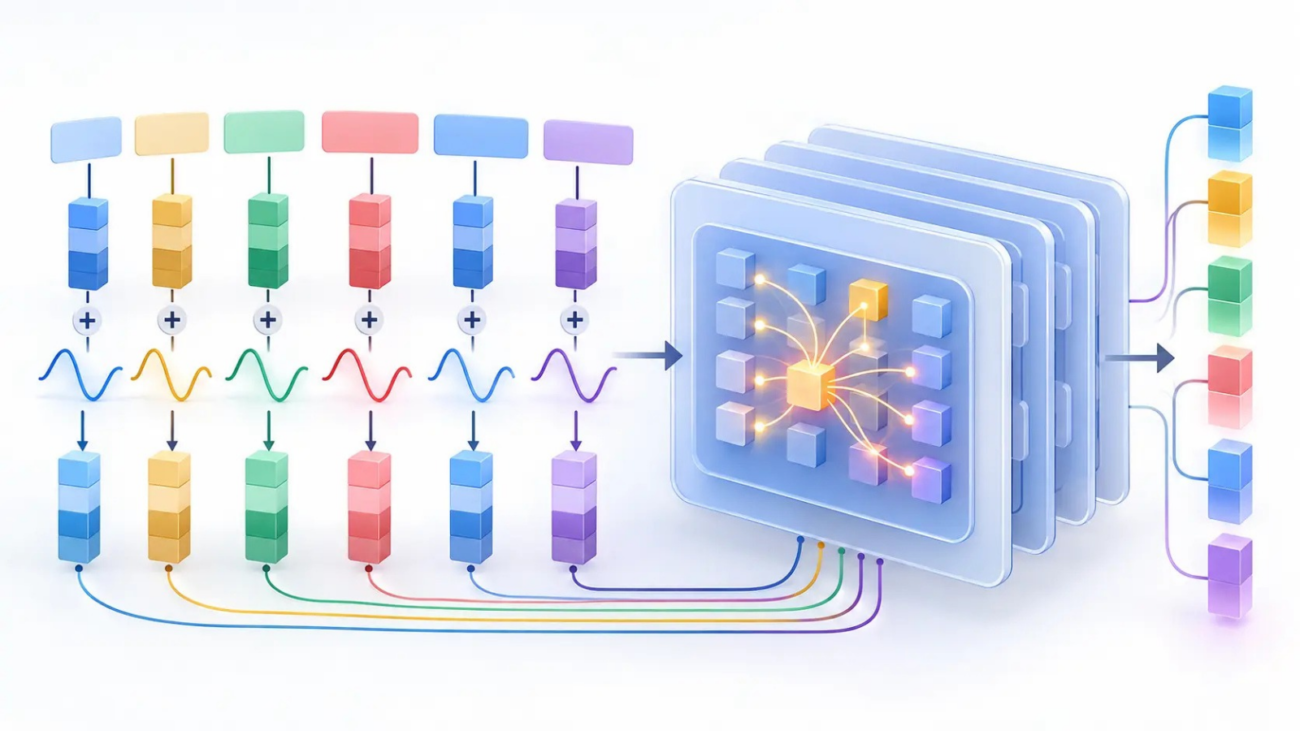
Positional encoding is data that tells a Transformer where a token is located in a sequence. A token already has a numerical representation that shows what it means, but that number alone does not tell the model whether the token appears at the beginning, middle, or end of a sentence. Positional information is added to the token representation so the model can use both pieces of information when processing text. This is especially important in natural language processing, where moving a word can change the meaning of a sentence.
Why Do Transformers Need It?
The need for information about where something is in a sequence comes from the way Transformers handle text. Earlier models, such as recurrent neural networks, processed text one step at a time, so the order of words was naturally included in the calculations. The Transformer introduced a different approach, using attention as the main way to handle sequences instead of processing them step by step. This made it easier to process multiple parts of a sequence in parallel, but it also meant that the model needed a clear way to represent the position of each token.
This idea becomes easier to understand with an example. Take the sentences “Sarah gave Tom the book” and “Tom gave Sarah the book.” The same names and words are present in both sentences, but their positions change who is doing what. Positional information helps a Transformer keep track of these differences, while self-attention determines how the different tokens should influence one another.
How Does Positional Encoding Work?
The original Transformer, introduced in the paper Attention Is All You Need in 2017 used positional encodings. Of giving each position a plain number such, as 1, 2 or 3 positional encoding creates a pattern of values by using sine and cosine functions. Each dimension uses a frequency so each position gets its own unique pattern. These values are added to the representations before the sequence enters the Transformer.
You do not need to work through the mathematics to understand the main idea. Each position receives a distinctive numerical pattern, and that pattern gives the model a way to recognize where a token appears.
How Does It Work With Self-Attention?
Self-attention allows each token in a sentence to consider information from other tokens. In a sentence such as “The dog ran after the ball” the word “dog” can interact with “ran” and “ball” as well as the other tokens in the sequence. This allows the model to look across the sentence instead of processing each word on its own. However self-attention does not naturally tell the model where each token appears. It needs additional information about position. This is where positional encoding becomes important.
Positional encoding gives the model information about where each token occurs in the sequence. When “dog” and “ball” are processed together the model has information about their content and their positions. This helps it understand the order of the sentence. It can then distinguish the original sentence from a different arrangement of the same words. Positional information therefore works alongside self-attention rather than replacing it.
Together these two mechanisms give the Transformer a better representation of the sentence. Self-attention helps the model learn which tokens are related. Positional information helps it keep track of where those tokens appear. This combination is an important part of how Transformer models can process language without reading every token one after another.
Are There Different Ways to Represent Position?
There are several ways to give a Transformer information about position. The original Transformer used sine and cosine functions to create positional encodings. These patterns were fixed rather than learned from training data. The encodings were then added to the token representations before they entered the model. Another approach uses learned positional embeddings. In this method the model learns useful representations for different positions during training. The values are adjusted as the model learns from data. This gives the model a flexible way to represent position.
A more modern approach is RoPE or Rotary Position Embedding. Instead of simply adding positional information to each token representation RoPE changes the Query and Key vectors according to their positions. This allows the attention mechanism to capture information about the relative positions of tokens. RoPE is used in many modern large language models.
Why Is Positional Encoding Important?
Language depends heavily on word order. “I eat apples” has a clear meaning. Changing the order can make the sentence confusing or change what it means. A Transformer therefore needs more than the words themselves. It also needs information about where those words appear. Without positional information a model would have difficulty distinguishing between different arrangements of the same tokens. It could still compare their representations. However the structure of the sequence would be much harder to understand. Positional encoding gives the model another signal that helps it work with ordered text.
This becomes even more important when a model processes long documents or conversations. Important words may be separated by many other tokens. The model needs to understand their relationships while still keeping track of their positions. Positional information helps provide that structure. This makes it an important part of natural language processing.
Final Thoughts
Positional encoding gives Transformers a way to understand order while self-attention connects information across a sequence. Self-attention helps the model determine which tokens are related. Positional information tells the model where those tokens appear. Together they help the Transformer understand both the content of text and its structure. The original Transformer used sinusoidal encoding. Later models introduced learned positional embeddings and techniques such as RoPE. The methods are different but they all address the same basic problem. A Transformer needs some way to understand position when it processes an ordered sequence.
Once you understand this connection the Transformer architecture becomes easier to follow. The tokens provide the information. Positional encoding preserves their order. Attention connects the different parts of the sequence. That combination plays an important role in how modern AI systems process language.
Sources