
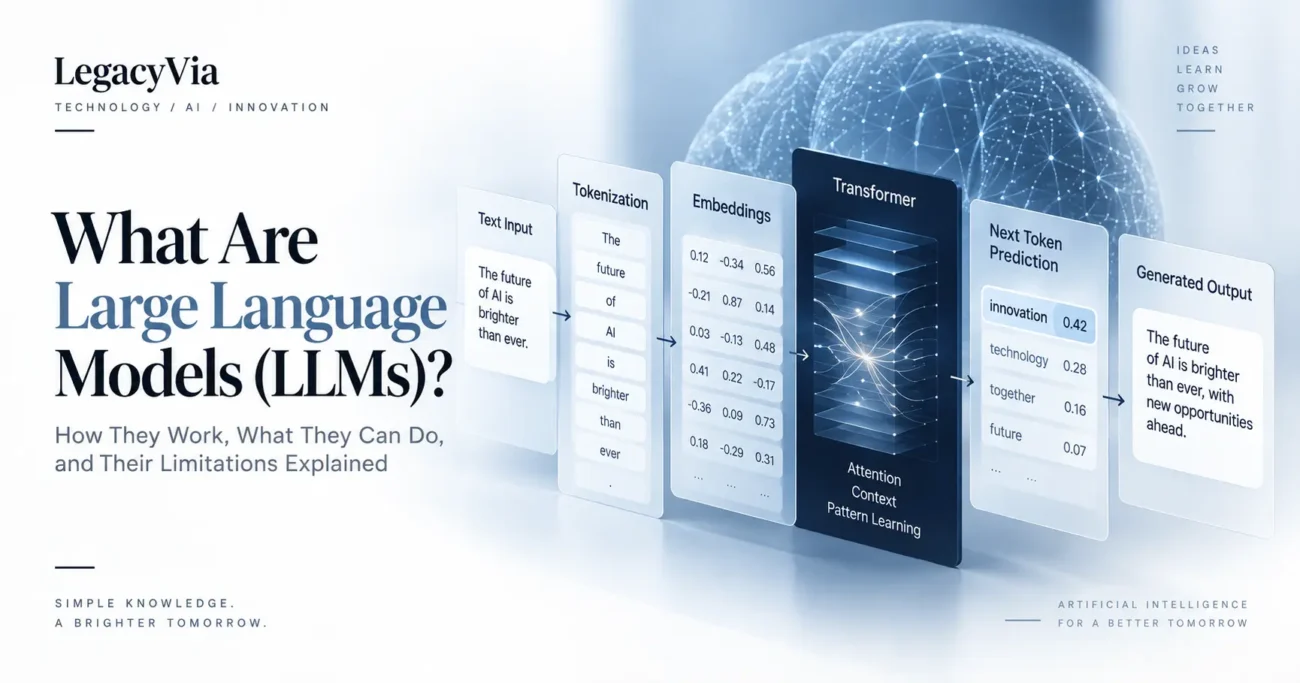
You have probably used an AI chatbot that can explain a difficult idea, summarize a long document, write code, or answer a question in seconds. Behind many of these everyday AI experiences is a technology known as a large language model, or LLM. To understand where LLMs fit in, it helps to start with the bigger picture: artificial intelligence is the broader field, while machine learning and deep learning are some of the methods that make modern AI systems possible. LLMs take these ideas further by learning patterns from enormous amounts of language data and using those patterns to generate text, answer questions, summarize information, translate languages, and perform many other tasks. In this guide, we will break down what a large language model actually is, how it learns and generates language, what role natural language processing and neural networks play, and why LLMs have become such an important part of today’s generative AI landscape. By the end, you should have a clear understanding of what happens behind the scenes when you type a question into an AI system.
What Is a Large Language Model (LLM)?
A large language model is a neural-network model built to work with language at scale. What makes an LLM different from a simple text-processing program is the way it is trained: instead of being given a fixed set of rules for every possible sentence, the model learns numerical patterns from large training datasets. Those patterns are stored through parameters, the adjustable values within the network that are updated during training.
Parameters can be thought of as part of the model’s internal structure. During training, the model makes predictions, measures how far those predictions are from the training target, and adjusts its parameters to reduce the error. Repeating this process across a very large number of examples allows the network to develop increasingly useful representations of language.
One reason this matters is context. The meaning of a word can depend heavily on the words around it. Consider the word bank: in “She deposited money at the bank,” it refers to a financial institution, while “They sat on the bank of the river” has a completely different meaning. A language model needs to account for these relationships rather than treating every word as an isolated unit.
Modern LLMs commonly use the Transformer architecture, which relies on attention mechanisms to process relationships between tokens in a sequence. The Transformer was introduced in the 2017 paper Attention Is All You Need and became a major foundation for subsequent language-model development.
This gives us a useful way to think about an LLM: the model’s parameters contain what it has learned, while its architecture determines how information is processed. When you provide a prompt, the trained model uses both to calculate an appropriate continuation of the input.
That raises a more practical question: what exactly does the model receive when you type a sentence into an AI system? Before an LLM can process your words, the text has to be converted into a form its neural network can work with.
How Do Large Language Models Work?
When you enter a question into an AI chatbot, the model does not receive your sentence in the same form that you see on the screen. The text first passes through several stages that turn it into information the neural network can process. The model then examines the relationships within that information and generates a response one token at a time.
A simplified view of the process looks like this:
From Your Text to an AI Response
Your prompt
Text becomes tokens
Tokens become numbers
Context is processed
Next token is chosen
Text is generated
Although the underlying mathematics is complex, this basic sequence makes it much easier to understand what happens inside an LLM.
The Text Is Broken Into Tokens
The first stage is called tokenization. An LLM does not necessarily treat every word as one unit. Instead, a tokenizer divides the input into smaller pieces called tokens. Depending on the tokenizer, a token may represent a complete word, part of a word, punctuation, or another piece of text.
For example, a sentence such as:
“Large language models are changing AI.”
is converted into a sequence of tokens before the model processes it.
This approach allows the model to handle words it has not encountered in exactly the same form during training. A longer or less common word can be divided into smaller pieces rather than requiring the model to have a separate representation for every possible word.
It is also worth remembering that tokens and words are not the same thing. The number of tokens in a piece of text depends on the tokenizer and the language being processed.
Tokens Are Turned Into Numerical Representations
Once the text has been tokenized, the tokens need to be represented mathematically. Neural networks work with numbers, not written words, so each token is mapped into a numerical representation known as an embedding.
An embedding is a vector of numbers that represents information in a form a machine-learning model can process. These representations can capture relationships between pieces of data, which allows the model to work with patterns and similarities rather than treating every token as a completely separate symbol.
At this stage, the original sentence has effectively been transformed from written language into a numerical form that can move through the model.
The Transformer Processes the Context
The numerical representations are then passed through the model’s neural-network layers. Modern LLMs commonly use the Transformer architecture, which was introduced in the 2017 research paper Attention Is All You Need. The architecture introduced an attention-based approach for processing relationships within sequences and became a major foundation for later language-model systems.
One of the Transformer’s most important ideas is attention. In simple terms, attention allows the model to consider how different tokens relate to one another instead of processing each token in isolation.
Consider this sentence:
“The student put the laptop in the bag because it was heavy.”
To interpret the sentence, the model needs to consider what “it” refers to. The relevant information may be several words away, so the model needs a mechanism that can take different parts of the sequence into account.
Attention helps provide that mechanism. Rather than simply moving through the sentence from beginning to end with no access to earlier relationships, the Transformer can calculate how strongly different parts of the input should influence one another.
The actual attention calculations are mathematical and considerably more detailed than this example suggests, but the basic idea is straightforward: the model uses context to determine which pieces of information matter to one another.
The Model Predicts What Comes Next
After processing the available context, the LLM generates the response by predicting the next token.
For example, consider:
“The capital of France is”
Based on its learned patterns, the model can assign probabilities to possible next tokens. “Paris” would be a highly likely continuation.
The model then uses the newly generated token as part of the context for the next prediction. This process continues repeatedly until the response is complete.
A simplified example is:
The capital of France is
→ Paris
→ .
A much longer answer follows the same basic idea, but with many more tokens and substantially more computation.
This is why the phrase next-token prediction is central to understanding language models. The model is not normally selecting an entire paragraph in one step. It generates a sequence incrementally, with each prediction influenced by the context available at that point.
The Tokens Become a Readable Response
After the model has generated the necessary tokens, they are converted back into text that can be displayed to the user.
From the user’s perspective, the entire process may feel almost instantaneous:
What appears to be a simple conversation is therefore the result of a long chain of mathematical operations carried out in a very short amount of time.
How an LLM Generates a Response
There is, however, one major piece still missing from this picture. The model needs to learn the patterns that make these predictions possible. That learning happens during training, when the model is exposed to large amounts of data and its parameters are adjusted repeatedly.
How Are Large Language Models Trained?
An LLM’s ability to generate language comes from training. During this stage, the model processes very large datasets and repeatedly practices predicting the next token. When its prediction differs from the expected result, the model’s internal parameters are adjusted. Repeating this process across a huge number of examples allows the model to gradually learn patterns in language, including grammar, word relationships, and context.
Pretraining
The first major stage is pretraining. The model is exposed to a broad collection of training data and learns by predicting what comes next in sequences of text. At the beginning, its predictions are largely inaccurate. Through repeated training, its parameters are updated so that future predictions become more accurate.
Post-Training
After pretraining, additional training can be used to make the model more useful for real interactions. This can include fine-tuning with carefully prepared examples and methods that use human feedback to improve how the model follows instructions and responds to users. The exact process varies between model developers and model families.
The result is a model that can take a new prompt it has never seen before and use the patterns learned during training to generate a response.
But learning from enormous amounts of data also introduces an important question: does an LLM actually understand what it is saying, or is it simply recognizing patterns?
Do LLMs Really Understand Language?
LLMs can produce remarkably fluent and relevant responses, but that does not necessarily mean they understand language in the same way people do. Their capabilities come from learning complex patterns in large amounts of data and using those patterns to generate language.
This distinction becomes clearer when an LLM is asked to deal with context, beliefs, or information that falls outside the patterns it has learned. Research has found that language models can perform strongly on many language tasks while still showing inconsistent understanding of human perspectives and beliefs.
So it is more accurate to think of an LLM as a highly capable language-processing and prediction system, rather than a human-like mind. It can recognize relationships, maintain context, and produce convincing language without having human experiences, intentions, or consciousness.
This difference also helps explain one of the most important limitations of LLMs: a response can sound confident and natural while still being incorrect. Understanding why that happens is the next step in understanding how these systems behave.
Sources & Further Reading
-
OpenAI. “What are tokens and how to count them.” OpenAI Help Center.Source ↗
-
Google for Developers. “Embeddings and embedding space.” Machine Learning Crash Course.Source ↗
-
Vaswani, A. et al. “Attention Is All You Need.” arXiv:1706.03762, 2017.Paper ↗
-
OpenAI. “How ChatGPT and our foundation models are developed.” OpenAI.Source ↗
What Are Large Language Models Used For?
LLMs are not limited to answering questions in a chat window. Because they can process and generate language, they can be adapted to a wide range of tasks involving text, code, and other forms of information.
One common use is writing and editing. An LLM can help draft an email, rewrite a paragraph, improve the clarity of a document, or change the tone of existing text. It can also summarize long documents by turning large amounts of information into shorter versions that are easier to review.
LLMs are also widely used for translation and language-related tasks. They can translate text, explain unfamiliar terms, and help people communicate across languages. In software development, they can assist with code generation, explanation, debugging, and documentation.
Another important use is powering AI assistants and chatbots. In these systems, the LLM is usually only one part of a larger application. Other components can provide access to external information, tools, memory, or application-specific instructions.
This flexibility is one reason LLMs have become a foundation for many generative AI applications. Rather than being built for only one task, a single model can support many different tasks through carefully designed prompts and additional software around it.
However, being useful across many tasks does not mean an LLM is always reliable. The same system that can produce a helpful explanation can also generate information that sounds convincing but is incorrect. Understanding these limitations is essential before relying on an LLM for important information.
Examples of Large Language Models
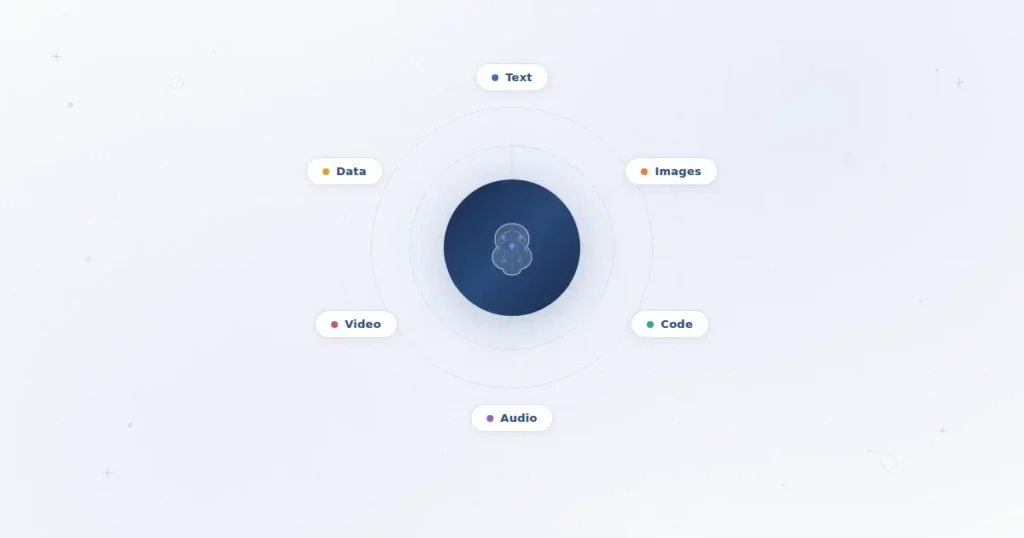
Large language models are developed by several organizations, and they can differ in architecture, training methods, capabilities, and how they are made available to users and developers. Some model families are designed primarily for general-purpose language tasks, while newer systems also support images, audio, video, tool use, and other forms of input.
GPT is a family of models developed by OpenAI and used across a range of AI applications. OpenAI’s current model documentation lists GPT models with support for tasks involving text and, for its latest models, image input as well.
Claude is a family of language models developed by Anthropic. Anthropic publishes model system cards describing the capabilities, evaluations, limitations, and deployment considerations of its Claude models.
Gemini is Google’s family of AI models developed by Google DeepMind. The Gemini family includes models designed for multimodal inputs such as text, images, audio, and video, with different models aimed at different workloads.
Llama is Meta’s family of large language models. Meta provides Llama models and developer resources for researchers and developers, including models that can be obtained directly or through partner platforms.
These examples show that LLM is a category, not the name of a single model. GPT, Claude, Gemini, and Llama are different model families developed by different organizations, but they all belong to the broader landscape of modern language models.
As this field changes quickly, the names and capabilities of individual models can change over time. For that reason, it is better to think of these as model families and platforms rather than a fixed list of the “best” LLMs.
What Makes an LLM “Large”?
The word “large” in large language model does not refer to a single measurement. It describes the scale of the model and the resources used to develop it. In particular, LLMs can involve very large numbers of parameters, extensive training datasets, and substantial computing resources during training. (IBM, Google Cloud)
Parameters
Parameters are numerical values inside a neural network that are adjusted during training. They help the model represent the patterns it learns from its training data. A model with more parameters has a larger capacity to represent complex patterns, although a higher parameter count does not automatically make one model better than another. Model architecture, training data, training methods, and other factors also affect performance. (IBM)
Training Data
Scale also comes from the amount and variety of data used during training. An LLM may be trained on large collections of text and other data so that it can learn patterns across different subjects, writing styles, and forms of language. The quality and composition of that data matter just as much as its size. (Google Cloud)
Computing Resources
Training a large model requires significant computing power because the model must process enormous numbers of training examples while repeatedly updating its parameters. This can require large clusters of specialized hardware and substantial time and energy. (Google Cloud)
So, in practice, “large” describes the overall scale of the model, its training data, and the computation required to train it. It is better understood as a combination of factors rather than simply a count of parameters.
That scale is one part of what makes modern LLMs capable of handling a broad range of language tasks, but it also makes them expensive and complex to train. The next question is what these models actually look like in practice and which well-known LLM families are being used today.
LLMs vs. Generative AI: What’s the Difference?
The terms large language model (LLM) and generative AI are often used together, but they describe different things. An LLM is a type of AI model designed primarily to process and generate language, while generative AI is a broader category of systems that can create new content such as text, images, audio, video, and code.
The relationship is easier to understand by looking at the scope of each term. Generative AI is the broader field, while an LLM represents one important class of models within that field. A system that generates a written answer can use an LLM, while a system that creates an image or produces audio may rely on a different type of generative model.
For example, a chatbot that writes an email may use an LLM to generate the text. An image-generation system, on the other hand, uses models designed for visual content rather than language alone.
So, the simplest distinction is:
Generative AI = the broader category
LLM = a language-focused type of AI model
This distinction matters because not every generative AI system is an LLM, even though many of the AI tools people use today rely on LLMs for language-based tasks.
Related: What Is Generative AI?
LLM vs. Chatbot: Are They the Same Thing?
An LLM and a chatbot are not the same thing. An LLM is the underlying AI model that processes and generates language, while a chatbot is an application designed to interact with people through conversation. A chatbot can use an LLM as its main language engine, but it may also include other components such as system instructions, external tools, databases, or a user interface.
For example, when you send a question to an AI chatbot, the LLM may be responsible for interpreting the request and generating the text of the answer. The application around it can handle other tasks, such as maintaining the conversation, connecting to external services, or retrieving additional information.
A simple way to think about the difference is:
LLM → the language model
Chatbot → the application that uses the model to communicate with you
This distinction becomes especially important as AI systems become more capable. Modern chatbots are increasingly built as larger software systems in which an LLM is only one part of the overall architecture.
What Is a Context Window?
An LLM can only work with a certain amount of information at a time. This available space is called the context window. It is measured in tokens and usually includes the information provided to the model as input and, depending on the system, the tokens it generates as output. The exact limit varies between models.
The context can include your current question, earlier messages in a conversation, instructions, and other information supplied to the model. A larger context window allows a model to consider more information within a single interaction. For example, a model with a large context window can work with much longer documents or conversations than a model with a smaller limit.
It is important to distinguish context window from memory. A context window describes the information available to the model during a particular interaction; it does not mean the model permanently remembers everything it has processed. Different AI applications may add their own memory or retrieval systems around the model, but those are separate components.
Context windows have also grown substantially across modern models. For example, current documentation from OpenAI lists models with context windows of around 1 million tokens, while Google documents several Gemini models with 1 million-token input context windows. These limits are model-specific and can change as newer versions are released.
Understanding context windows also helps explain why an LLM may sometimes lose access to earlier information in a very long interaction. Once information falls outside the model’s available context, it may no longer be directly available for that particular generation.
This becomes especially important when working with large documents, knowledge bases, or external information. Instead of placing everything into the prompt, modern AI systems can use techniques such as retrieval to provide the model with the most relevant information when it is needed.
That idea leads naturally to another important technology in modern AI: Retrieval-Augmented Generation, or RAG.
Why Do LLMs Make Mistakes?
Large language models can produce answers that sound clear and confident but are not always accurate. These errors are often called hallucinations or, in some technical literature, confabulations. They can include incorrect facts, invented references, or answers that appear plausible but are not supported by reliable evidence.
One reason is connected to how LLMs generate text. The model is trained to recognize patterns in language and predict likely next tokens. That process can produce fluent text even when the model does not have enough reliable information to answer a particular question. OpenAI notes that models can sometimes generate a confident answer when acknowledging uncertainty would be more appropriate.
Mistakes can also arise when a question is ambiguous, highly specific, or depends on information the model does not have access to. For example, an LLM may give an incorrect date, create a citation that does not exist, or combine pieces of information in a way that sounds reasonable but is factually wrong.
This is why an LLM’s fluency should not be confused with guaranteed accuracy. For important information—especially in areas such as health, finance, law, or current events—AI-generated answers should be checked against reliable and up-to-date sources. NIST likewise identifies inaccurate or inconsistent generated content as an important risk associated with generative AI systems.
The good news is that developers are actively working on reducing these errors through better training, evaluation, tools, retrieval systems, and methods that encourage models to express uncertainty rather than guess.
Limitations of Large Language Models
Large language models can be incredibly useful, but they are not perfect. They can write a clear explanation, help with code, or summarize a document in seconds, yet the result still needs to be treated with some care. An answer that sounds confident is not necessarily a correct one.
One of the biggest limitations is accuracy. As we saw earlier, an LLM can sometimes generate information that is incorrect or misleading. It may misunderstand a question, rely on incomplete context, or produce an answer that sounds reasonable even when the underlying information is wrong. This is one reason important information should still be checked against reliable sources.
LLMs can also reflect biases in the data used to develop them. Since models learn from large collections of human-created information, the patterns they learn can sometimes contain unwanted biases. Researchers and developers continue to work on identifying and reducing these problems, but they have not been completely eliminated. (NIST)
Another limitation is context. Every model has a limit on how much information it can process in a single interaction. Even with large context windows, very long conversations or documents can create challenges, particularly when important information is buried among a large amount of text.
There are also practical concerns such as privacy, cost, and computing requirements. Using an AI system responsibly means being careful about the information you provide, especially when it contains sensitive or personal data.
None of this makes LLMs less useful. It simply means they work best when their strengths are understood alongside their weaknesses. For everyday tasks, an LLM can be a powerful assistant, but for important decisions or factual claims, human judgment and reliable sources still matter.
Sources & Further Reading
Sources are provided for verification and further reading. Technical details and model capabilities may change as AI systems are updated.
FAQ’s
What does LLM stand for?
LLM stands for Large Language Model. It refers to an AI model designed primarily to process and generate language by learning patterns from large amounts of data.
How does an LLM work?
An LLM processes text as tokens, converts them into numerical representations, and uses a neural-network architecture to examine the context before predicting what token should come next. The process is repeated until a complete response is generated. This builds on concepts such as deep learning, neural networks, and natural language processing.
Is ChatGPT an LLM?
ChatGPT is an AI application that uses language models. An LLM is the underlying model, while ChatGPT adds the interface and other system components that allow people to interact with it.
Are LLMs the same as generative AI?
No. An LLM is a type of language-focused AI model, while generative AI is a broader category that includes systems capable of generating text, images, audio, video, code, and other content.
Why do LLMs sometimes give incorrect answers?
LLMs generate responses from patterns learned during training and the context available to them. This means they can sometimes produce information that sounds convincing but is incorrect. For important topics, their responses should be checked against reliable and current sources.
Can LLMs understand language like humans?
LLMs can process context and produce highly capable language, but that does not mean they understand language in exactly the same way humans do. Their behavior comes from learned patterns and computational processes rather than human experience or consciousness.
What are LLMs used for?
LLMs can support many language-based tasks, including writing, summarization, translation, coding, question answering, and conversational AI. Their flexibility is one reason they have become an important part of modern artificial intelligence and generative AI systems.



3 thoughts on “What Are Large Language Models (LLMs)? How They Work”