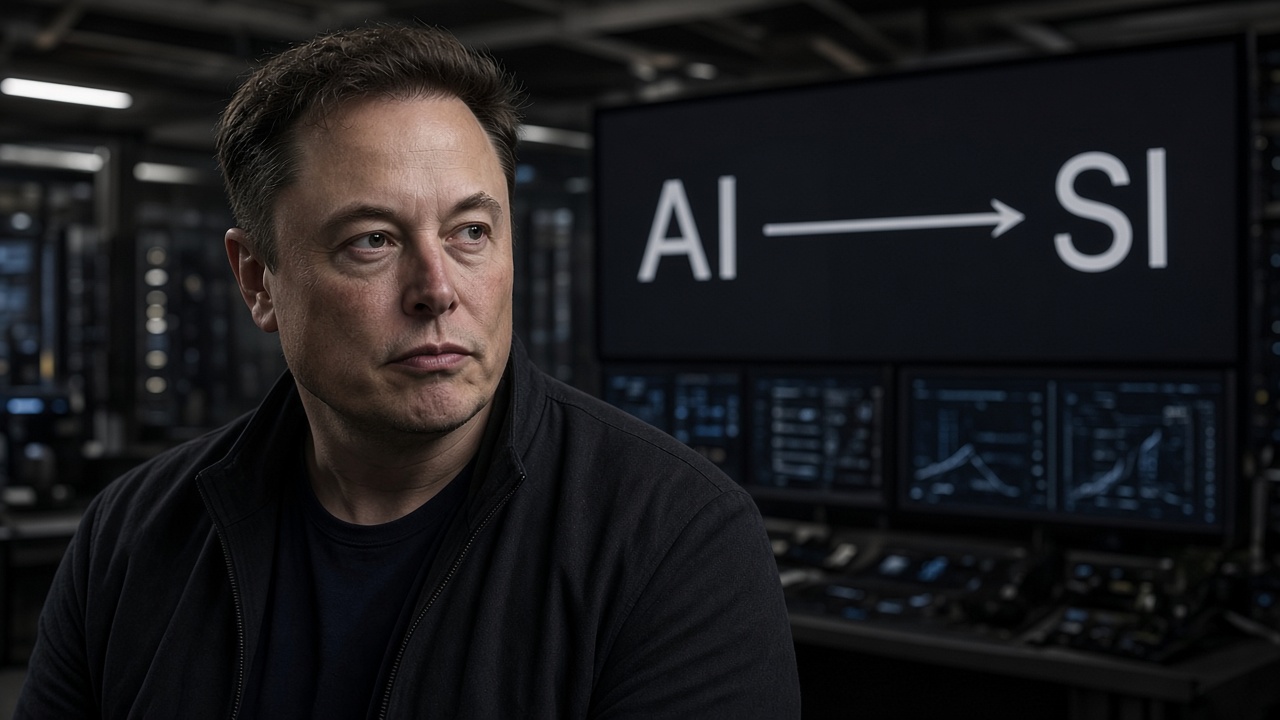
On Sunday, October 4, 2026, Elon Musk posted on X, “No more AI. SI. It’s better.” He later confirmed that SpaceXAI will be renamed SpaceXSI and described SpaceX as a “super intelligence company.” The comments came just five days after President Donald Trump signed an executive order directing federal agencies to use “Super Intelligence” (SI) instead of “artificial intelligence” (AI) in specified government communications.
Musk’s comments do not mean that artificial intelligence is ending or that superintelligence has already arrived. Instead, they highlight a growing shift in how advanced AI is being described. The White House has introduced the new terminology in a government policy context, while Musk is now adopting it for his own AI operations.
Here’s what Musk actually said, what Trump’s executive order changes, what superintelligence means in the traditional AI context, and what remains uncertain. For readers new to the subject, our guide to artificial intelligence provides the basics before we look at what comes next.
What Did Elon Musk Actually Say?
Musk’s “No more AI. SI. It’s better” comment appeared in an X thread responding to a user who questioned whether the word “artificial” still fits systems that can build or improve themselves. A public archive of Musk’s posts preserves the exchange. In a follow-up reply Musk said that plenty of humans are still involved. He added that fewer people may be needed as superintelligence becomes better at improving itself.
Musk also addressed the future of SpaceXAI in the discussion. When a user asked whether it could become SpaceXSI Musk replied, “Yes, we will make that change.” He also described SpaceX as a “super intelligence company.” Musk did not give a date for the rename. For now it should be treated as a planned branding change rather than a completed one. He did not provide a detailed explanation for why he prefers “SI” over “AI” so any claims about his motives should be treated as interpretation rather than fact.
Why Is Musk Using “SI” Instead of “AI”?
The timing points to Washington. On September 22, Trump told the United Nations General Assembly that U.S. government documents would use “super intelligence.” The Associated Press reported that the State Department later told diplomats in one bureau to change the wording. Five days later Trump signed an executive order directing federal agencies to use “Super Intelligence” and “SI” instead of “artificial intelligence” and “AI” in specified communications. Axios reported that Musk also used the term at a White House event after catching himself saying “AI.”
Musk has not said that Trump’s policy is the reason he prefers “SI” so that connection remains an inference. His own comments do suggest that he sees the term as more than a simple rebrand. In the same X discussion he linked “SI” to systems that can improve themselves with less human involvement. That suggests a technical meaning behind his choice as well as the wider policy shift.
What Trump’s “Super Intelligence” Order Actually Changes
Executive Order 14434, titled “Inaugurating the Era of Super Intelligence,” was signed by President Donald Trump on September 29, 2026. It directs executive departments and agencies to use “Super Intelligence” and “SI” instead of “Artificial Intelligence” and “AI” in official correspondence, public communications, websites, reports, policy documents and other non-statutory documents. The order also makes clear that previously issued regulations, contracts, presidential actions and historical documents do not have to be rewritten.
The most important detail is in the order’s definition section. For now, “Super Intelligence” and “SI” refer to the technologies already covered by the federal definition of artificial intelligence under 15 U.S.C. § 9401(3). That law defines AI as a machine-based system that can make predictions, recommendations or decisions for human-defined objectives and influence real or virtual environments. The order gives the president’s science and technology adviser 60 days to propose a federal definition of SI and consider whether it should change or replace the existing legal definition of AI.
That distinction matters. The order changes the language used by the executive branch but does not establish that current AI systems have reached technical superintelligence. It also does not require private companies to stop using the term AI. For now, the shift is mainly about government terminology while a broader definition of SI is still being considered.
What Does “Super Intelligence” Mean?
The term superintelligence is not new. In AI research it has a more specific meaning than the way “SI” is being used in the current U.S. policy debate. Philosopher Nick Bostrom described superintelligence as an intellect that “greatly exceeds the cognitive performance of humans in virtually all domains of interest.” The important point is the breadth of that ability. A system that performs better than people at one task would not normally be considered superintelligent. Axios also noted that the term already has a long-standing meaning in discussions about advanced AI.
The terms AI, AGI and superintelligence are often used together, but they describe different ideas. AI is the broad term used for systems that perform tasks associated with human intelligence. AGI generally refers to a system with broad abilities across many types of intellectual work. Superintelligence describes a hypothetical level at which a system would outperform humans across virtually all cognitive domains. The boundaries between these concepts are still debated and there is no single test accepted by everyone.
| Term | Plain-English meaning | Current status |
|---|---|---|
| AI | Systems that perform tasks associated with human intelligence such as understanding language, recognizing images or generating content | Widely used today |
| AGI | A system with broad intellectual abilities across many different fields | Research goal; definitions vary |
| Superintelligence (ASI) | A system that greatly exceeds humans across virtually all cognitive domains | Hypothetical in traditional AI research |
For readers who want to understand the technology behind modern AI systems, our guides to machine learning and artificial intelligence provide the basics.
Is Today’s AI Really Superintelligence?
Modern AI systems are capable enough to make the term feel relevant. Generative AI can write and summarize text, translate languages and generate code and images. Many of these systems rely on large language models built with the transformer architecture. AI systems have also outperformed humans in specific tasks for years. IBM’s Deep Blue famously defeated world chess champion Garry Kasparov in 1997.
But performing better than humans at a particular task is not the same as being broadly more intelligent than humans. Bostrom’s framework distinguishes between systems that are superhuman in one area and a general superintelligence that exceeds human abilities across virtually all cognitive domains. A chess engine may be far better than a person at chess while being unable to perform tasks outside its narrow purpose. Today’s AI is much more flexible. It can still produce incorrect answers and often requires people to set goals, provide data and review its output.
There is also no widely accepted test showing that a current AI system has reached the traditional definition of superintelligence. Trump’s executive order does not attempt to answer that question either. Musk’s own comments describe an ongoing shift in which humans remain involved while systems become better at improving themselves. That points to a developing process rather than a clearly defined end state.
The distinction matters because greater capability does not automatically equal superintelligence. The White House is using “SI” as a new policy term for technology currently covered by the federal definition of AI. In AI research, however, superintelligence still describes a much higher level of general cognitive ability.
Why Is SpaceXAI Becoming SpaceXSI?
Musk has said SpaceXAI will become SpaceXSI, but the change had not yet appeared on the company’s websites or social media when Reuters and Euronews reported the announcement. Musk also gave no date for when the new name would take effect. For now the rename remains a plan rather than a completed rebrand. (Reuters)
The business began as xAI, the company Musk founded in 2023 behind the Grok chatbot. SpaceX acquired xAI in February 2026 and the business later adopted the SpaceXAI name. Grok is part of the growing group of consumer-facing AI tools that have brought advanced AI into everyday use. The official xAI developer changelog records a SpaceXAI rebrand on June 16. A move to SpaceXSI would therefore be another name change only a few months later.
Musk has not publicly given a business reason for the new name. The timing does place the move alongside the Trump administration’s push to use “Super Intelligence” instead of “Artificial Intelligence.” That may be part of the appeal for Musk, but there is no direct statement from him confirming that this is why SpaceXAI is being renamed. To understand the broader technology behind this debate, see our guide to artificial intelligence.
Is the AI Industry Actually Moving From AI to SI?
Not as a whole, at least not yet. The evidence is mixed, and one company plus a few executives is not an industry. On the “SI” side, Axios reported that Nvidia CEO Jensen Huang has adopted the term, calling data centers “super intelligence factories.” Meta’s Mark Zuckerberg has used superintelligence branding for some time, and Meta renamed its AI efforts Meta Superintelligence Labs in June 2025, a use that predates the order.
On the other side, Axios reported that several executives at the White House event kept saying “AI,” and that company representatives did not expect “SI” to catch on beyond government settings. Reporting from the Washington Examiner shortly after the order said Anthropic, OpenAI, Google, Meta, SpaceXAI and Nvidia would not say whether they planned to adopt the terminology. A YouGov poll cited by Axios found 53% of respondents preferred “artificial intelligence,” against 9% for “super intelligence.”
Why the Name Change Matters
What follows is interpretation, not established fact. Axios framed the new label as part of an effort to shift the narrative amid public backlash over data centers and job worries, evoking promise without the old baggage. On TechCrunch’s Equity podcast, Kirsten Korosec described the White House summit as largely a rebranding exercise. Those are journalists’ readings, not official statements.
Three practical effects are worth watching. Perception is one: “super” implies beyond-human ability, which could raise both expectations and fears. Policy is another, because the definition drafted over the next 60 days could matter more than the label, since definitions decide which systems fall under which rules. Clarity is the third. Federal documents may say SI while statutes still say AI, and readers may blur today’s systems with hypothetical future ones. The field has been through this tension before, and the history of AI includes stretches when researchers avoided the term.
What Happens Next?
Several things will show whether this is a lasting shift or a short news cycle:
- Whether SpaceXAI formally changes its website, X account and filings to SpaceXSI. Musk gave no date.
- Whether Musk offers a fuller explanation of what he means by SI.
- Whether other technology companies adopt the term outside their dealings with the federal government.
- The proposed federal definition due about 60 days after September 29, which will show whether SI gets a meaning distinct from AI.
- Whether “SI” shows up in everyday and technical usage, which polls like YouGov’s can track.
TechCrunch also reported that Trump announced a new Super Intelligence Force over the weekend. We will keep following the story in our AI coverage.
FAQ’s
He was advocating “SI” as the preferred term. He has not given a formal explanation, though a follow-up reply tied SI to systems that improve themselves. It does not mean AI technology is ending.
SI stands for Super Intelligence. In the executive order, it means the same technologies federal law already calls AI. In research, superintelligence means far exceeding humans across virtually all cognitive domains.
For implementing the order, yes: it defines SI by reference to the federal AI definition. In research usage, no. Superintelligence is a much stronger concept.
AI is the broad category of machine systems that perform tasks needing human-like judgment. AGI would match people across most intellectual tasks. Superintelligence would far exceed them across virtually all of them. Researchers disagree on definitions and on how close any system is to the higher levels.
Musk said “we will make that change” in reply to a user’s question. Reporters connect it to Trump’s order, but Musk has not confirmed that motive, and the rename has not yet been completed.
Only within the executive branch, and only for non-statutory documents. The order relies on the existing legal definition of artificial intelligence and does not change statutes.
Nothing in the White House documents or news coverage reviewed shows that. The order uses the term as a policy label, and whether any system meets the research definition is contested.
That is unknown. A few executives have embraced SI, but others kept saying AI, the order does not bind private companies, and polling so far favors the old term.
Conclusion
The important development is not that AI has ended. Musk is promoting “Super Intelligence” as a preferred term while the U.S. government has started using “SI” in its policy language. For now, however, the executive order uses the same technology that federal law already defines as AI. Whether “SI” becomes a wider replacement for “AI” remains unclear. The next signs to watch are whether SpaceXAI completes its move to SpaceXSI and what definition of superintelligence the White House proposes by the end of November. Until then, the shift is more about language and policy than a confirmed change in what today’s AI systems can do.
Source :
Click
- Elon Musk Archive: X thread, October 4, 2026
- The White House: Executive Order 14434, “Inaugurating the Era of Super Intelligence” (September 29, 2026)
- The White House: Fact Sheet on the Era of Super Intelligence order
- Cornell Legal Information Institute: 15 U.S.C. § 9401
- Axios: Trump and CEOs try to shed AI’s toxic branding (October 1, 2026)
- Axios: Trump orders AI rebrand as “super intelligence” (September 22, 2026)
- Associated Press via ABC News: US diplomats told to use “super intelligence”
- Euronews: Musk to follow Trump and rebrand SpaceXAI as SpaceXSI (October 5, 2026)
- TechCrunch: Can “super intelligence” and a non-binding safety pact solve AI’s image problem? (October 4, 2026)
- Washington Examiner: AI companies hold off on embracing Trump’s “super intelligence” rebrand